

Header image: Anantara Convento di Amalfi Grand Hotel
For centuries, convents and monasteries have turned out artisanal skincare. Now it’s having a moment.
With TikTok minting new beauty trends hourly at this point, most are soon lost to the churn. But every so often, an outlier becomes part of the broader cultural conversation. Perhaps you remember one such moment from not too long ago: “TikTok Nun Goes Viral for Skincare Routine,” in the words of the Kelly Clarkson Show segment that followed.

The Benedictine Sisters
of Perpetual Adoration in
Missouri known for their
Monastery Creations
No question: Sister Monica Clare—the 59-year-old author of a new memoir and mother superior at New Jersey’s Community of St. John Baptist— has a preternaturally youthful glow. (Her secrets? Sun avoidance, a colloidal oatmeal cleanser and good lighting.) But she’s hardly the first convent- based beauty influencer. That honor may well go to Hildegard of Bingen, more widely known as St. Hildegard, the 11th-century abbess, mystic, composer, and “doctor of the church” who was such a gifted herbalist that numerous modern skincare collections are named in her honor: Hildegaard Haute Botanical, Les Jardins de Sainte Hildegarde, and Hildegard’s Way, to name a few.


But as St. Hildegard’s TikTok-famous counterpart has made clear, there’s something about monastic self-care that feels especially appealing right now. “I think we’re just all overwhelmed with the chaos of the modern world,” says esthetician Athena Hewett, founder of the San Francisco-based spa and skincare brand Monastery. “So we’re looking for something quiet and simple.” And if the cult status of Hewett’s creations is any indication, she’s clearly on to something.
Consider that she’s become a Fashion Week fixture, with several stretches of 2025 set aside for skincare residencies in New York, Paris, and Copenhagen that correspond to the shows. In each city, she partners with local hotels and spas (Manhattan’s fabled Hotel Chelsea, for one) to offer facials. While she books up quickly with models, media, and show attendees, the services are available to the public, and locals jump at the chance to experience her nourishing, less-is-more approach.


Hewett comes by her craft honestly: “My yaya [a Greek grandmother] was an herbalist,” she says. “I would go herb-picking with her and watch as she would make concoctions.” And as much as those experiences inspired Hewett’s career path, so did childhood visits to her ancestral homeland. “Every summer, we were seeing family and going to monasteries in Greece,” she says, adding, “I loved the ritualistic aspect of a monastery, the scents—and the quiet.” Thus the approximation you’ll find at her San Francisco spa, from the hushed chanting you’ll hear over the sound system to the organic Greek sage you’ll experience in some of the formulations, not least, her Sage Cleansing Oil. (The line’s newest addition, a moisture-shielding serum called Glass, is debuting in late 2025.)
While Hewett’s products are monastery-inspired, others are literally monastery-made—perhaps most notably, Fresh Crème Ancienne. Another cult favorite, this one is a modern homage to one of the world’s oldest moisturizer formulations: a nearly 2,000-year-old Roman recipe that intrigued Fresh’s founders, Lev Glazman and Alina Roytberg. The catch? Even an updated version would require hand-mixing to allow for higher-than-usual percentages of waxes (soothing chamomile wax, for one) and oils (such as nourishing meadowfoam seed oil).
“We thought, ‘where can we get really incredible, luxury-level handwork?’” Roytberg told The Wall Street Journal during a rare look behind the scenes of the cream’s production. “Monastic orders often support themselves with handwork—the work itself is part of the spiritual life. It sounded crazy, but it made sense.”
The job ultimately went to a silent French order at a secluded monastery in the Czech countryside, where monks heat, cool, portion out, and smooth the formulation by hand between five daily chapel services and the other requirements of monastic life.
Of course, some of those requirements—taking time to look inward, for one—are precisely what calls to the wider world right now. Consider the case of Anantara Convento di Amalfi, a grand hotel and spa in the revived remains of a medieval convent. In addition to treatments that evoke the candlelit corridors of old monasteries (the candle massage, for one), the property offers a beloved series of friar-led experiences.
Friar Marcus, who oversees the hotel’s chapel, leads contemplative grounds tours, meditation sessions, even monastic-style lunches. Each one is highly immersive, “reflecting our motto: Pace & Bene—‘peace and all good,’” says the friar, adding that the message clearly resonates with 21st-century guests. “It often happens that they are profoundly moved and touched, as these experiences can reach deep within.” Of course, the location doesn’t hurt either: “a 13th-century Capuchin convent perched on a cliff more than 260 feet above the sea, offering an emotionally impactful setting, rich in history, as well as a serene retreat.”


Friar Marcus
Indeed, monasteries-turned-resorts and spas have proliferated in some of the world’s most sublime spots, from the foothills of the Andes (Palacio Nazarenas, A Belmond Hotel) to the massif of the Luberon (Le Couvent des Minimes Hotel & L’Occitane Spa). But you need not travel to benefit from centuries of monastic wellness wisdom.
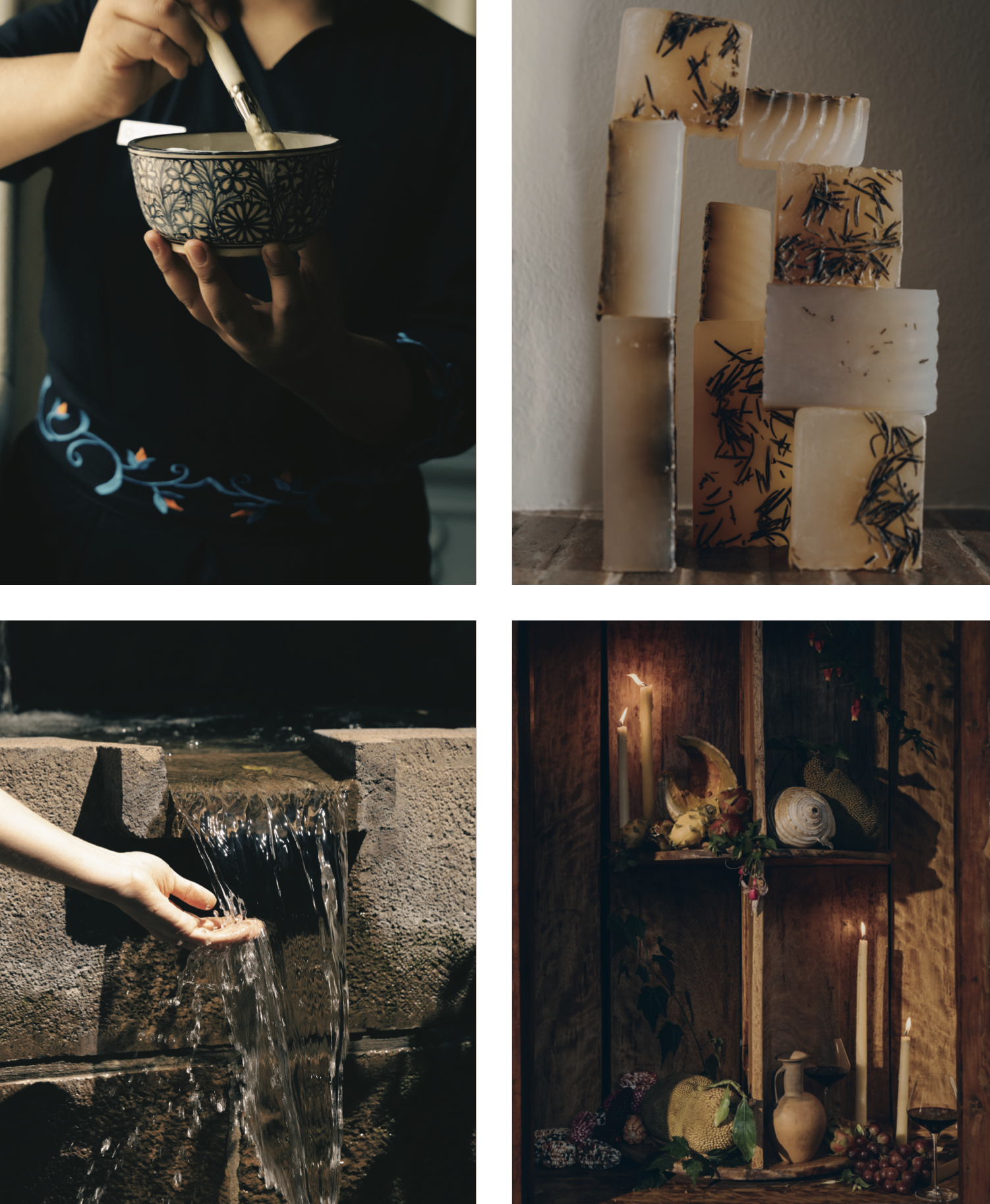
Photos courtesy of Palacio Nazarenas, A Belmond Hotel
Florence’s fabled Officina Profumo-Farmaceutica di Santa Maria Novella, a convent-based business dating to the 1200s, now ships icons such as the milk- and pomegranate-infused Melograno Soap and the Medici-commissioned Acqua della Regina fragrance internationally. Indeed, monks and nuns around the world are increasingly taking to ecommerce, from the Benedictine Sisters of Perpetual Adoration in Missouri, who make the soap, scrubs, and salves in the Monastery Creations collection to the Greek Orthodox residents of the Vatopedi monastery on Mount Athos, purveyors of handmade soaps back in Athena Hewett’s motherland.
She recalls collecting plenty of Greek monastery soaps of her own, along with endless little bottles of holy water—the contents of which her yaya would dab on for protection. But you need not be among the faithful to crave the ritualistic wellbeing that monasteries evoke. Especially in 2025. Everyone’s “crazy, noisy lives” are only getting noisier, she observes. “We need that moment to just have our own little quiet ritual.”


The post Conventional Beauty Wisdom appeared first on Organic Spa Magazine.